netviz

802.11 · WiFi

OWE the open network that encrypts anyway

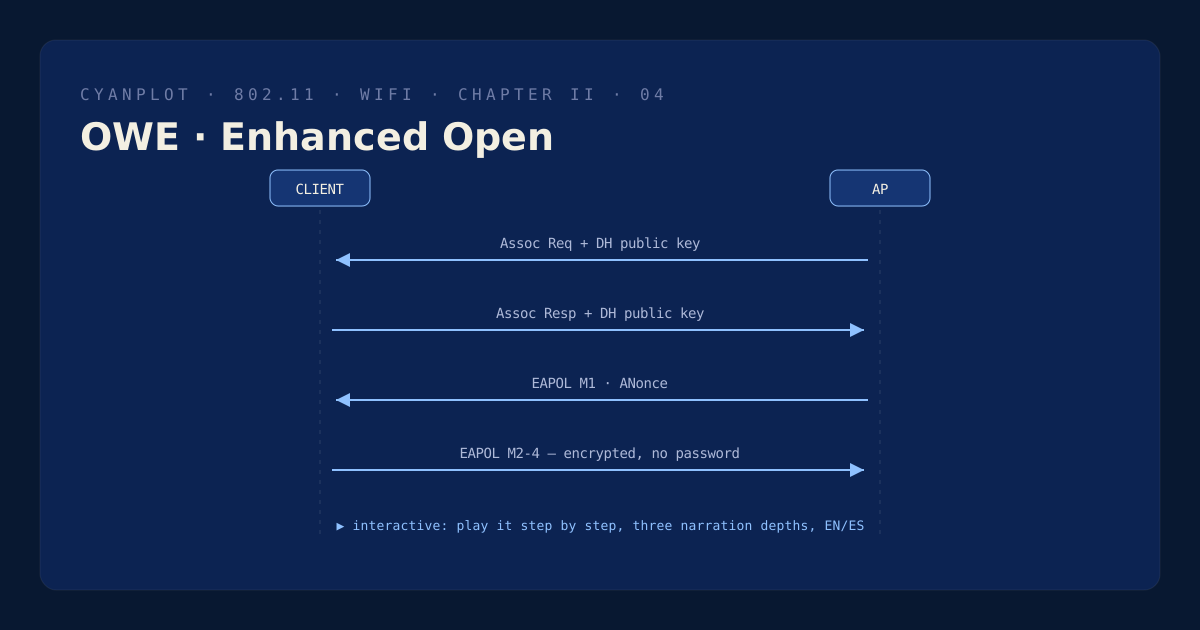
The café network asks for no password — and still encrypts every frame you send, with keys your neighbor doesn't share. OWE conjures protection out of thin air. This plate shows the trick, and the one thing it cannot do.

Sequence diagram poster of the WPA2 4-way handshake

Requesting scene from the content service…

RFC 8110
Enhanced Open
Diffie-Hellman
keys from thin air
per-client keystransition modeevil twinencryption ≠ authentication

What you'll learn

  • How an ephemeral Diffie-Hellman exchange rides inside ordinary association frames to create a per-client master key.
  • Why every OWE client gets different keys — and why coffee-shop neighbor-sniffing dies even without a password.
  • How transition mode silently splits one 'open' SSID into a legacy cleartext side and an encrypted OWE side.
  • Why Wi-Fi 6E requires OWE for all open networks on 6 GHz.
  • The honest limit: OWE encrypts the pipe but never authenticates the far end — the evil-twin scenario, replayed step by step.

Encryption without a secret to share

Open networks were the last bastion of cleartext Wi-Fi: nothing to type meant nothing to derive keys from, and every frame flew readable. OWE (Opportunistic Wireless Encryption) closes that gap with the oldest trick in modern cryptography — Diffie-Hellman. During association, each side contributes a public key; both combine halves into a shared secret no observer can reconstruct; the standard 4-way handshake turns it into session keys.

The result reads like a contradiction: a network with no password where every client holds unique encryption keys. The person at the next table cannot read your traffic — not because a portal said so, but because the math says so.

What it solves, what it doesn't

OWE defeats the passive listener — the laptop quietly capturing a café's traffic. It does not defeat the active impostor: an evil twin broadcasting the same network name completes OWE happily and terminates your 'protection' itself. Encryption is not authentication, and this plate's failure scenarios make the difference tangible: the legacy device that lands on the cleartext half of a transition pair, and the attacker that OWE encrypts a tunnel straight into.

Atlas index