netviz

802.11 · WiFi

From lease to the web DORA · ARP · DNS · TCP

Joining the Wi-Fi got you through the door — but you still have no address, no gateway, no names and no connections. One plate, four figures: DORA hands you an identity, ARP puts a face to the gateway, DNS turns a name into an address, and TCP opens the conversation.

Sequence diagram poster of the WPA2 4-way handshake

Requesting scene from the content service…

DORA
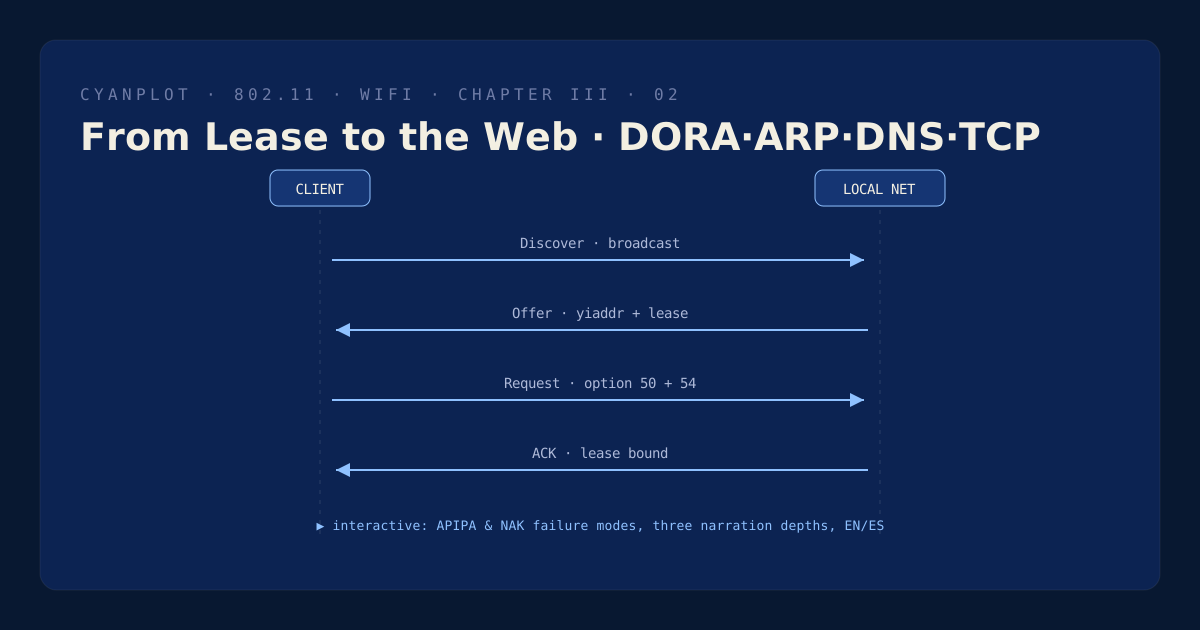
Discover · Offer · Request · ACK
169.254.x.x
APIPA fallback
gratuitous ARPrecursive DNSTCP 3-way handshakeDHCP NAK

What you'll learn

  • Why a device with no IP must broadcast — and how Discover, Offer, Request and ACK negotiate a lease (and why configuration applies only at the ACK).
  • What gratuitous ARP announces, how duplicate addresses are caught, and how the gateway's MAC is resolved before any packet can leave the subnet.
  • How a recursive DNS query turns a name into an address, and why TTLs — not 'propagation' — decide when changes are visible.
  • What each leg of the TCP 3-way handshake establishes: sequence numbers, options, and the moment a connection becomes ESTABLISHED.
  • The classic failures on the wire: Discovers with no Offer ending in APIPA 169.254.x.x, the server's flat NAK, filtered SYNs versus instant RSTs — and each one's capture signature.

The problem DORA solves

After associating and encrypting the link, a device is standing inside the network with no identity: no IP address, no gateway, no DNS. It cannot ask a specific server for help because finding servers is exactly the thing it cannot do yet. DHCP resolves this chicken-and-egg with the bluntest tool in networking — the broadcast — and a four-message negotiation nicknamed DORA: Discover, Offer, Request, ACK.

The exchange is a tiny auction. The client shouts its need to everyone, any server may answer with an offer reserved from its pool, the client publicly accepts exactly one — naming the chosen server so the losers can recycle their reservations — and the chosen server ratifies the lease. Only that final ACK configures anything.

Why engineers care about a 'solved' protocol

DHCP fails loudly in user terms and quietly on the wire. The single most common help-desk symptom — connected to Wi-Fi, nothing loads — is very often a DORA that never completed: a relay agent missing on the client's VLAN, an exhausted pool, a rogue or misconfigured server. Each failure leaves a distinct signature: repeated Discovers with no Offer, a client falling back to a self-assigned 169.254.x.x address, or a NAK forcing the whole negotiation to restart.

The interactive plate replays both the healthy exchange and those failure scenarios step by step, at three narration depths — a plain analogy, the protocol details with options and timers, and the operations view with capture filters and the commands that close tickets.

Atlas index