netviz

802.11 · WiFi

Wi-Fi 6E the 6 GHz era

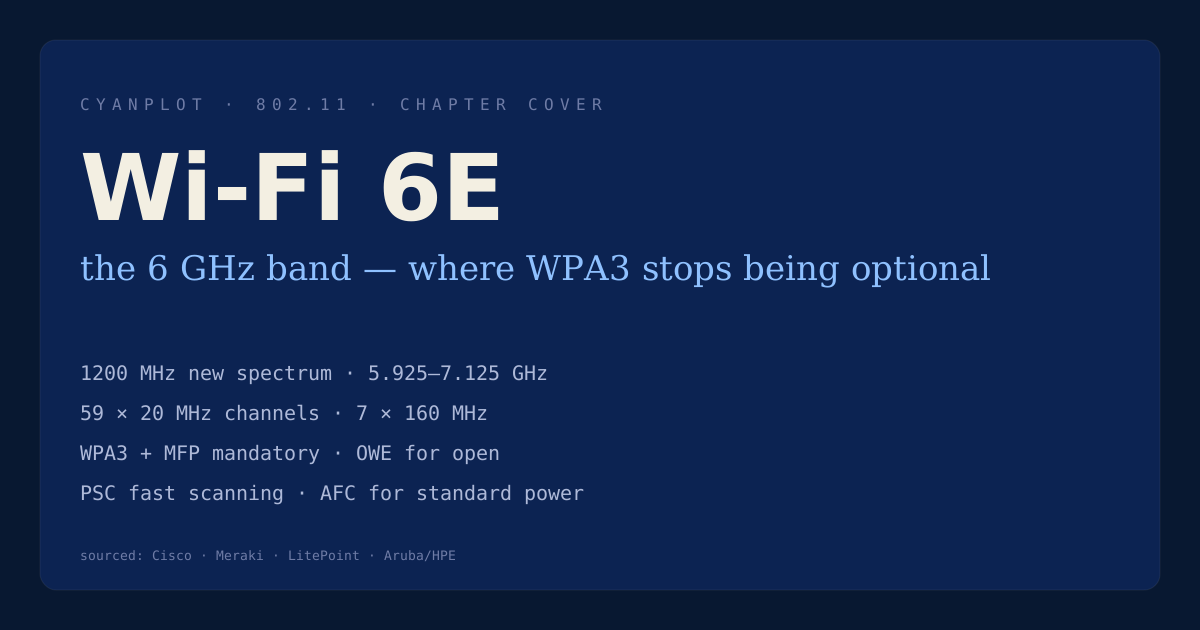
Wi-Fi 6E is Wi-Fi 6 with a new, almost empty highway — the 6 GHz band. 1200 MHz of fresh spectrum, and a hard rule baked in: the old weak locks aren't allowed here. This chapter cover sets up the modern-security plates that follow.

Sequence diagram poster of the WPA2 4-way handshake

Requesting scene from the content service…

1200 MHz
new spectrum
59 channels
fresh 20 MHz each
mandatory WPA3 + MFPOWE for openPreferred Scanning ChannelsAFC

What you'll learn

  • How much spectrum 6 GHz adds (1200 MHz, 5.925–7.125 GHz) and what the wider channels enable.
  • Why WPA3 and Management Frame Protection are mandatory on 6 GHz — no WEP, no WPA2-only, no plain open.
  • Why open networks must use OWE (Enhanced Open) on the band.
  • How Preferred Scanning Channels keep discovery fast across 59 channels.
  • What AFC (Automated Frequency Coordination) is and why standard-power APs (indoor or outdoor) need it.

A new band with non-negotiable rules

For two decades Wi-Fi shared the crowded 2.4 and 5 GHz bands. Wi-Fi 6E (802.11ax extended into 6 GHz) adds up to 1200 MHz of brand-new spectrum — 59 fresh 20 MHz channels including seven non-overlapping 160 MHz channels for the first time. Those full figures are the US/FCC allocation; the EU, UK and much of the world opened only the lower ~500 MHz (5.925–6.425 GHz), about 24 channels. The capacity is transformative; the conditions attached to it are the point of this chapter.

On 6 GHz, security is not a setting. WPA3 and Management Frame Protection are mandatory, transition modes that allow legacy fallbacks are forbidden, and open networks must run OWE. Discovery changes too — Preferred Scanning Channels keep a full band scan from taking several seconds — and standard-power deployments (indoor or outdoor) must consult an Automated Frequency Coordination (AFC) database to protect incumbent users of the spectrum.

Atlas index