netviz

802.11 · WiFi

Sharing the air CSMA/CA vs OFDMA vs MU-MIMO

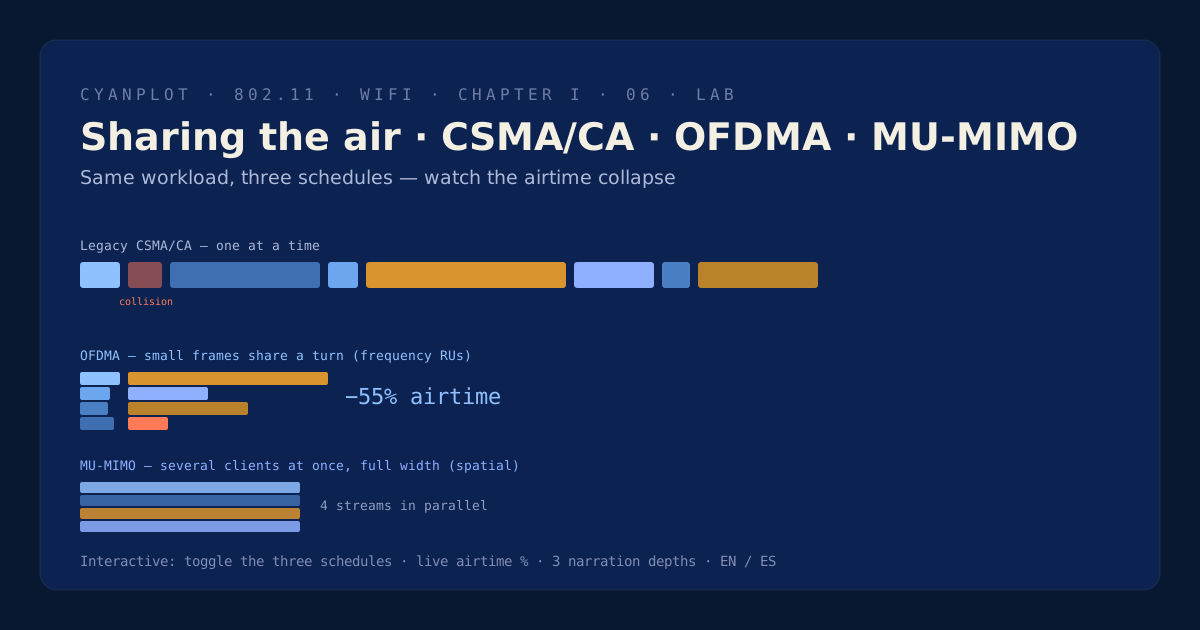
Wi-Fi is one shared room where devices take turns, and every turn carries overhead. Schedule the same workload as legacy CSMA/CA, then OFDMA, then MU-MIMO, and watch the same messages finish in less and less time. It's the clearest way to see why dense Wi-Fi is about airtime, not Mbps.

Sequence diagram poster of the WPA2 4-way handshake

Requesting scene from the content service…

OFDMA
frequency Resource Units
MU-MIMO
parallel spatial streams
CSMA/CAper-frame overheadairtime, not MbpsResource Units

What you'll learn

  • Why CSMA/CA spends most airtime on per-frame overhead (backoff, preamble, ACK) — not payload.
  • How OFDMA packs many small frames into one transmission across frequency Resource Units.
  • How MU-MIMO serves several clients at once in space, and when that beats OFDMA.
  • Why a single legacy client still taxes every turn — and why airtime, not link rate, is the budget.

Airtime is the real budget in dense Wi-Fi

A stadium or lecture hall isn't slow because each link is slow — it's slow because hundreds of devices serialise behind the overhead of taking turns. This lab takes one fixed workload (a room of phones, sensors and a couple of big streams) and schedules it three ways. Legacy CSMA/CA gives every frame its own turn with fixed overhead and the occasional collision. OFDMA splits the channel into Resource Units so many small frames share one turn. MU-MIMO uses spatial streams to serve several clients at once on the full width.

Toggle between the three and the same blocks reflow while the total-airtime bar collapses — typically a large reduction for the small-frame-heavy traffic that dominates real networks. The lab is honest about the trade-offs: OFDMA wins for many small/latency-sensitive flows, MU-MIMO for a few big downlink-heavy ones, and a single legacy client keeps forcing a full-overhead turn no matter what.

Atlas index