netviz

802.11 · WiFi

Wi-Fi 7 deep-dive MLO, 320 MHz, 4096-QAM up close

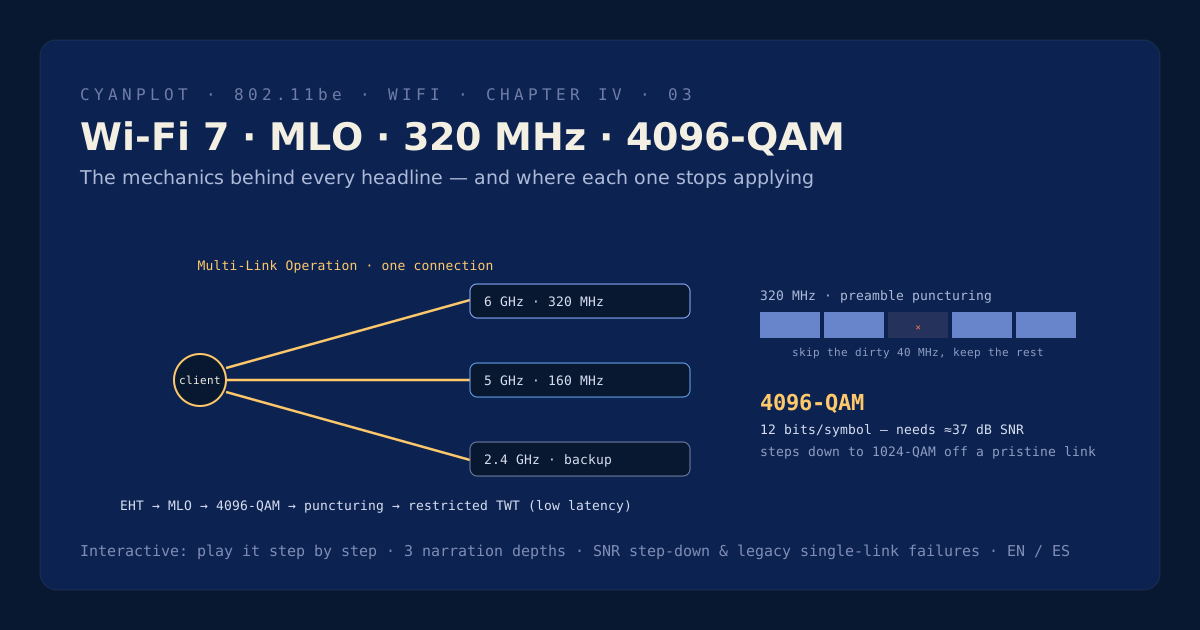
Wi-Fi 7 isn't just a bigger number. Follow one connection as it claims a 320 MHz lane on 6 GHz, binds two bands into a single Multi-Link connection, packs 12 bits per symbol on a pristine link, punches a hole around interference instead of shrinking, and reserves protected time slots for your video call. See the mechanics behind every headline — and where each one quietly stops applying.

Sequence diagram poster of the WPA2 4-way handshake

Requesting scene from the content service…

320 MHz
channel on 6 GHz
~40 dB SNR
4096-QAM demands it
12 bits
per symbol
Multi-Link Operationpreamble puncturingrestricted TWTAP MLD

What you'll learn

  • Why 320 MHz exists only on 6 GHz, and what an AP MLD actually is.
  • How Multi-Link Operation binds bands into one connection (STR vs eMLSR) under one security association.
  • Why 4096-QAM needs ~40 dB SNR — and steps down to 1024-QAM the moment the link isn't pristine.
  • What preamble puncturing / Multi-RU and restricted TWT (rTWT) really do for wide channels and latency.

The mechanics behind the headlines

The generations comparator lab quantifies the jump from Wi-Fi 4 to 7; this plate shows the machinery. A single Wi-Fi 7 connection exercises each headline feature in turn: EHT discovery and a 320 MHz channel on 6 GHz, a Multi-Link association that treats two bands as one connection, 4096-QAM on a clean link, preamble puncturing that keeps a wide channel alive around a noisy sub-block, and restricted TWT that reserves protected airtime for real-time traffic.

It is also honest about the limits. 4096-QAM needs roughly 40 dB of SNR and steps down to 1024-QAM a few decibels later — so it appears only very close to the AP. And a Wi-Fi 6 client on the same network simply associates single-link with none of the new features. The two failure scenarios make those realities concrete: a clean rate step-down, and graceful legacy coexistence.

Atlas index