netviz

802.11 · WiFi

Wi-Fi Generations Compared Wi-Fi 4 to Wi-Fi 7

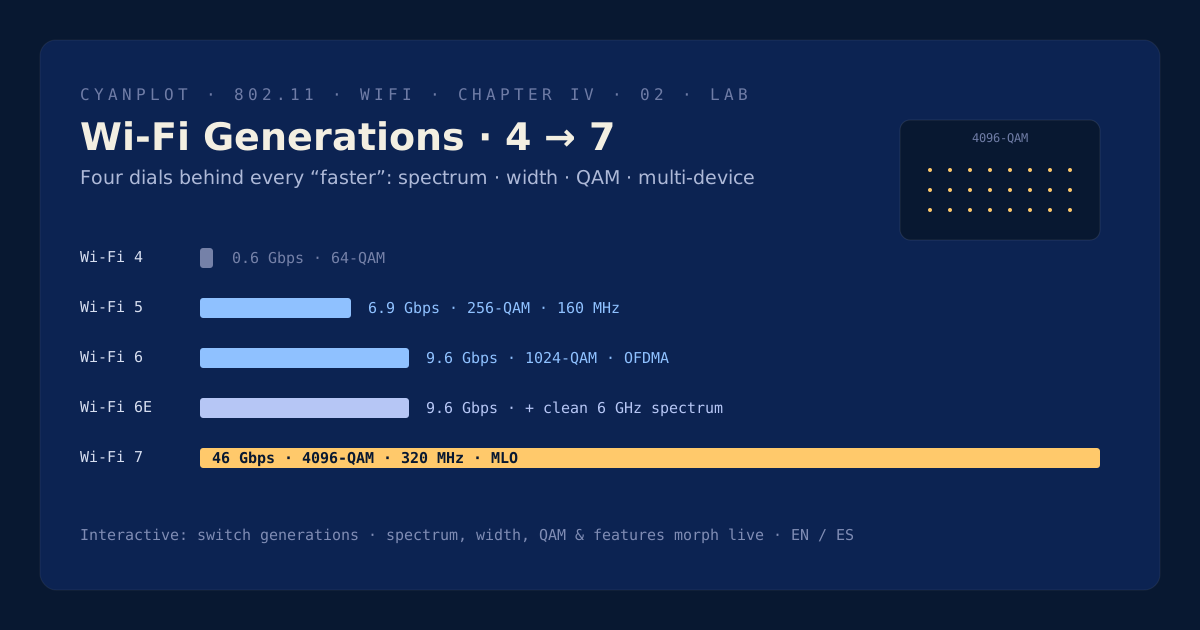
Every couple of years a new Wi-Fi number promises 'faster' — but the leap hides four very different dials: spectrum, channel width, modulation density and multi-device smarts. Switch between Wi-Fi 4, 5, 6, 6E and 7 and watch each dial move, so you can see exactly where the jump really came from.

Sequence diagram poster of the WPA2 4-way handshake

Requesting scene from the content service…

9.6 Gbps
Wi-Fi 6/6E PHY peak
64 → 4096
QAM densifies
streams × width × QAM × efficiencyOFDMABSS coloringMLO

What you'll learn

  • How peak Wi-Fi speed decomposes into streams × channel width × QAM density × efficiency.
  • Why Wi-Fi 6E shares Wi-Fi 6's PHY peak (9.6 Gbps) and only adds clean 6 GHz spectrum.
  • What 4096-QAM buys (and why it rarely matters) versus what 320 MHz and MLO buy in Wi-Fi 7.
  • Which capabilities — OFDMA, MU-MIMO, BSS coloring, TWT, 6 GHz, MLO — actually change a network.

'Faster' is four dials, not one

A headline Wi-Fi rate is the product of four factors: how many spatial streams the radios run, how wide the channel is, how densely bits are packed onto each subcarrier (the QAM order), and how efficiently the airtime is used. Each generation pushed a different subset — so 'faster' means something different every time.

This comparator lets you switch between Wi-Fi 4, 5, 6, 6E and 7 and watch the spectrum bands light up, the channel-width bar stretch, the QAM constellation densify from 64 to 4096 points, the feature matrix reveal what's new, and the peak-throughput bar race — turning the marketing number back into the engineering that produced it.

Atlas index