netviz

802.11 · WiFi

QAM under noise why higher density needs a cleaner link

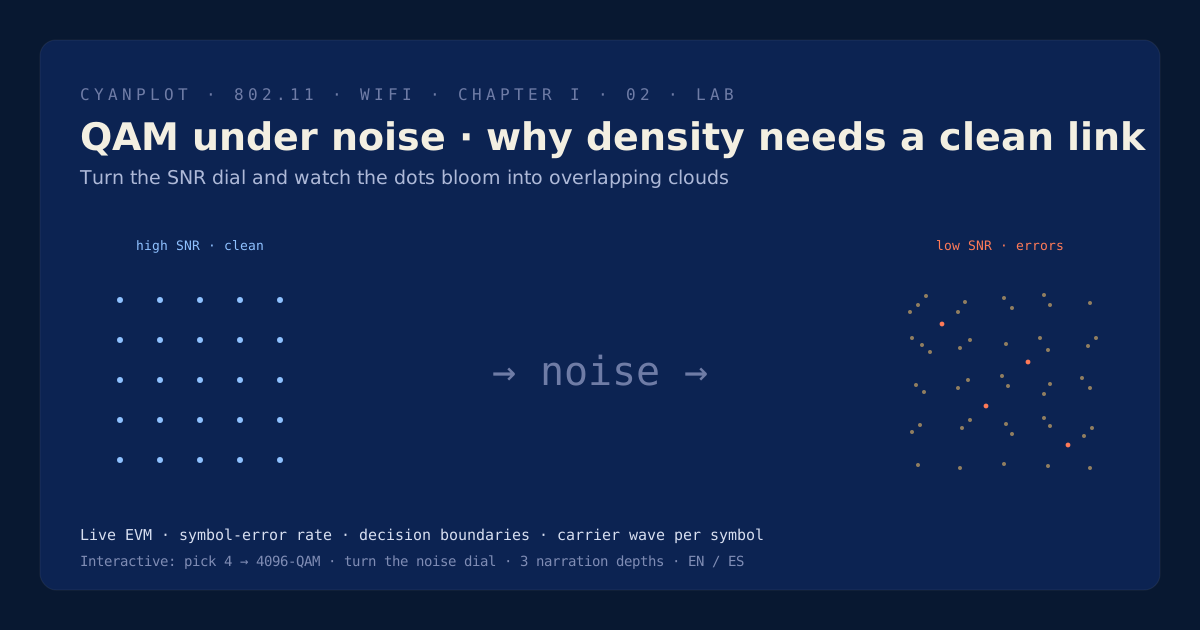
Textbooks draw QAM as tidy dots and stop there. This lab adds the part they leave out: noise. Choose a constellation, turn down the signal-to-noise, and watch the grid dissolve into overlapping clouds — that's a bit error, live. It's the clearest way to feel why the fastest Wi-Fi modes only exist on short, clean links.

Sequence diagram poster of the WPA2 4-way handshake

Requesting scene from the content service…

4096-QAM
densest constellation
+6 dB
SNR per QAM step
minimum distanceEVMdecision boundarySNR, not RSSI

What you'll learn

  • How a QAM symbol encodes bits as a unique amplitude-and-phase point — shown on the carrier wave itself.
  • Why denser constellations (smaller minimum distance) need proportionally higher SNR — about +6 dB per step.
  • What EVM measures, and how a received point crossing a decision boundary becomes a symbol error.
  • Why 4096-QAM is an SNR artifact of proximity, not a coverage target — and why SNR, not RSSI, is the number to carry.

Density and cleanliness are the same coin

Every Wi-Fi signal carries data by setting a wave's amplitude and phase to one of a fixed set of patterns — the constellation. 'Higher QAM' means more patterns packed closer together, so each transmission carries more bits. The catch is geometric: the closer the points, the less noise it takes to mistake one for its neighbour. This lab lets you turn a noise/SNR dial and watch each ideal point bloom into a fuzzy cloud, with the carrier wave drawn for individual symbols so you can see what a 'point' actually is.

When a cloud spills across a decision boundary into a neighbour's region, that's a symbol error — and the lab counts them live alongside the EVM and the SNR each order needs. It makes the minimum-distance argument visible instead of asserting it, and turns 'why am I not getting the rated speed?' into something you can see: high-order QAM simply isn't available unless the air is quiet and you're close.

Atlas index