netviz

802.11 · WiFi

WPA3-SAE a password no dictionary can crack

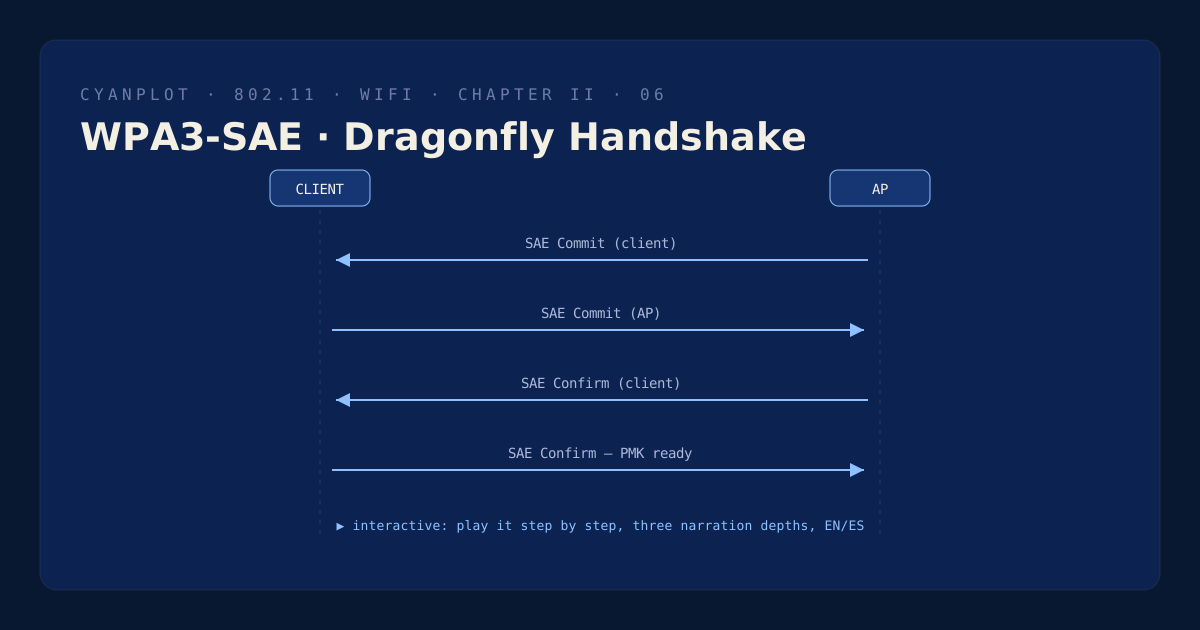
WPA2 proved you knew the password by deriving keys from it — which is exactly why recordings of it can be cracked. WPA3 plays a different game: both sides solve a puzzle seeded by the password and compare answers. The recording is worthless. This plate shows the whole exchange, move by move.

Sequence diagram poster of the WPA2 4-way handshake

Requesting scene from the content service…

SAE
Dragonfly handshake
forward secrecy
past captures stay sealed
PWEcommit / confirmno offline guessingstatus 31

What you'll learn

  • How SAE maps a password to a point on an elliptic curve (the PWE) and why commits look like pure randomness to an eavesdropper.
  • What the commit/confirm exchange proves, and why mutual authentication completes BEFORE association — the reverse of WPA2's timeline.
  • What forward secrecy buys you: why a captured session stays sealed even if the password leaks years later.
  • Why a wrong password fails in one clean exchange (no WPA2-style retry loops) and yields nothing crackable.
  • Where Wi-Fi 6E fits: 6 GHz mandates WPA3/OWE with protected management frames — and what status 31 means when an old device can't follow.

The flaw SAE was built to close

WPA2-Personal had one structural weakness: everything descended from the passphrase. Record one 4-way handshake, take it home, and every guess of the password can be tested offline, billions per second, forever. Strong passphrases survive; human ones often don't.

SAE — Simultaneous Authentication of Equals, the Dragonfly key exchange — removes the thing the attacker needs: an offline test. The password never produces transmittable proof. Instead it seeds a position on an elliptic curve from which both sides build commitments mixed with fresh randomness. Each side proves it reached the same shared secret; the secret itself depends on randomness that dies with the session.

What changes operationally

A wrong password dies in a single clean confirm mismatch — no retry storms, and nothing in the capture to brute-force. Every guess costs a live exchange with the access point, which rate-limiting turns into a dead end. And because the resulting master key is not a function of the password alone, yesterday's captures stay sealed even after a password leak: forward secrecy.

The plate also covers the migration reality: management frame protection (802.11w) is mandatory, which is what actually breaks older IoT — and on Wi-Fi 6E's 6 GHz band there is no transition mode at all. The interactive failure scenarios replay both stories: the wrong password, and the right password on the wrong hardware.

Atlas index