netviz

802.11 · WiFi

WPA3-Enterprise 192-bit the CNSA suite

Enterprise Wi-Fi at its strictest: no passwords at all, mutual certificates, a 192-bit-strength cipher suite (GCMP-256) end to end, and no weak fallback. Watch EAP-TLS prove both the server and your device, then derive GCMP-256 keys that also protect the network's own management frames — and see why WPA3-Enterprise is allowed on 6 GHz while legacy WPA2-Enterprise is not.

Sequence diagram poster of the WPA2 4-way handshake

Requesting scene from the content service…

192-bit
CNSA suite
GCMP-256
the data cipher
mutual EAP-TLSBIP-GMAC-256MFP requiredno transition mode

What you'll learn

  • What the CNSA / 192-bit suite pins: 802.1X-SHA384, GCMP-256, BIP-GMAC-256, EAP-TLS, MFP required.
  • Why mutual EAP-TLS removes passwords — and the evil-twin attack — from the picture entirely.
  • How requiring MFP structurally blocks the deauth-flood that kills open and WPA2-Personal networks.
  • Why 'no transition mode' is both the security win and the hardest operational constraint.

Strong-only, end to end

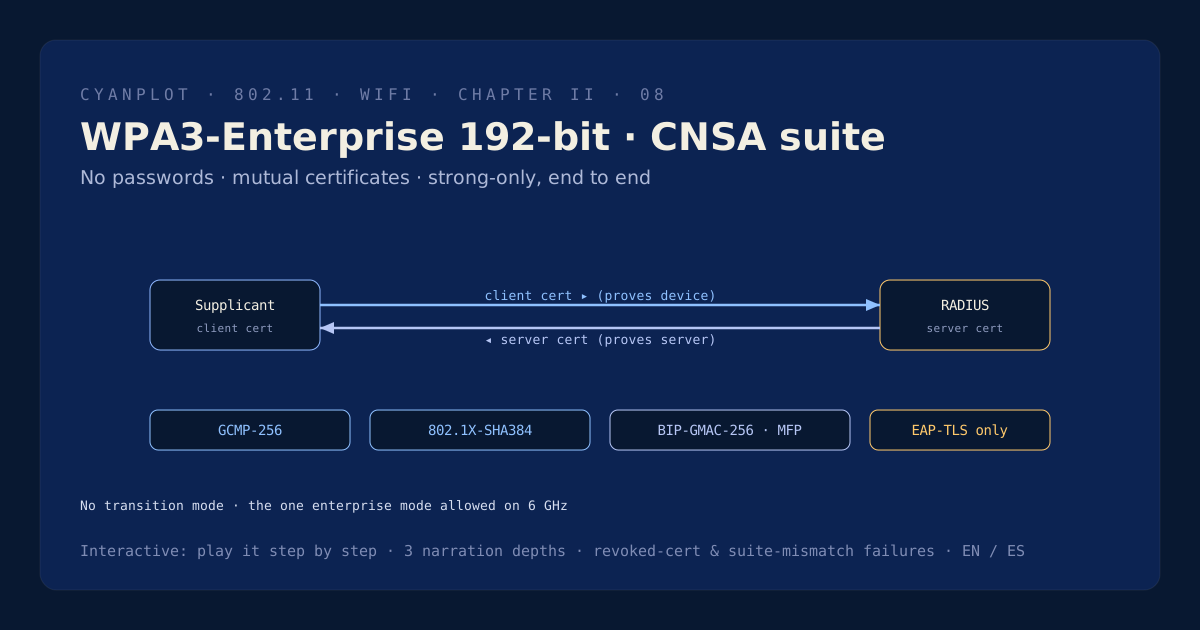
WPA3-Enterprise 192-bit mode (the CNSA suite) aligns the entire link to one audited cipher set with no downgrade path: 802.1X with SHA-384, GCMP-256 for data, BIP-GMAC-256 for management protection, and EAP-TLS as the only authentication method. Both sides present certificates — the server proves it is genuine and your device proves it is enrolled — so there is no password to phish, steal or crack.

The plate follows the same 802.1X spine as the WPA2-Enterprise plate, then shows where it hardens: mutual certificate validation, an MSK fed through SHA-384 key derivation, and a 4-way handshake that produces GCMP-256 keys plus an IGTK that protects management frames. It also walks the two real failure modes — a revoked or expired client certificate (a PKI lifecycle event the user cannot fix), and a client that simply cannot meet the strong-only suite and is turned away at association.

Atlas index